

I'd never actually read X's open source algorithm until recently. When I finally did, I found a file called param.rs that holds the scoring weights X uses to decide which posts live or die in the For You feed.
Most of the growth advice people repeat about X turns out to be backwards. Likes barely matter. Reposts barely travel. Hashtags do almost nothing. And the action that matters most is one most people never think about.
I first shared what I found in a Reddit post in my own community. This is the longer version. I went back to the code, checked every number, corrected a couple of things I got wrong and added the one rule I care about most, which is never to post copied text as it is.
One note before we start. X updates its public repository almost every day, and weights do change. The numbers here come from the xai-org/x-algorithm repository on GitHub as of its November 19, 2026 update. If you're reading this months later, check the file yourself.
How X decides what you see
Every time someone opens For You, X builds their feed from scratch. In plain words, it works like this.
- It gathers candidates. Some are recent posts from accounts you follow. Others come from accounts you don't follow, found by matching what a post is about to what you've engaged with.
- It predicts your actions. A model called Phoenix looks at your recent activity and predicts, for each post, how likely you are to like it, reply, repost, copy the link, block the author and so on.
- It scores each post. Each predicted chance is multiplied by a weight, and the results are added up into one score.
- It filters and sorts. Posts that are too old, already seen, or from people you've muted or blocked are removed. The rest are ranked by score.
The weights in step 3 are the part everyone wants to see, so let's start there.
The weights that move the needle
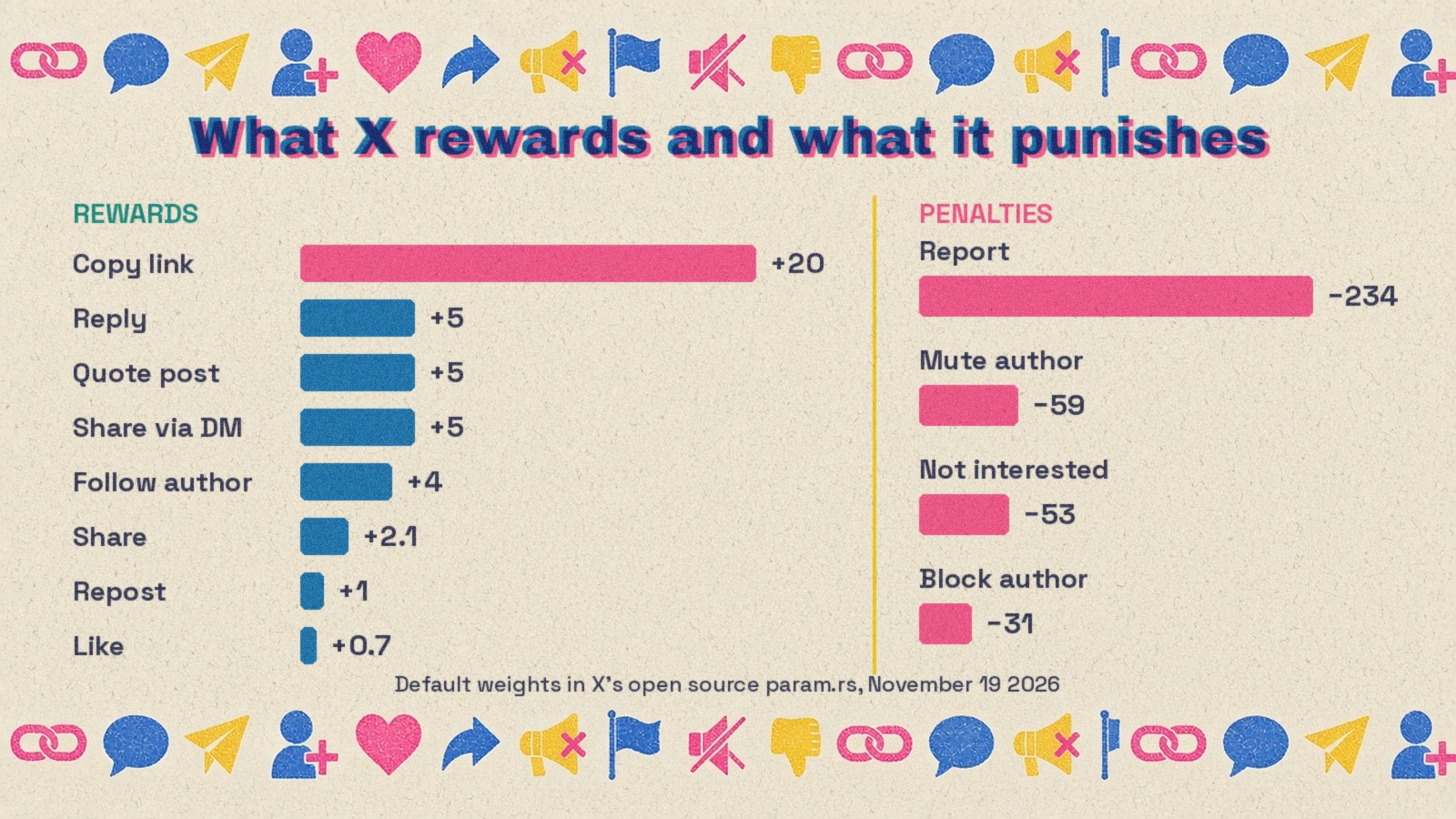
Here's the cheat sheet from home-mixer/params/param.rs, so you don't have to dig through the code yourself.
| Action | Weight | What it tells me |
|---|---|---|
| Copy link | +20 | The biggest positive signal by far, about 28 times a like |
| Reply | +5 | Conversation beats passive scrolling |
| Quote post | +5 | Five times a plain repost |
| Share via DM | +5 | Same "send this to a friend" energy |
| Follow author | +4 | The post made someone want more of you |
| Share | +2.1 | Useful, but far behind copy link |
| Repost | +1 | Close to a rounding error |
| Like | +0.7 | Feels nice, does very little |
| Block author | −31 | A strong penalty |
| Not interested | −53 | Worse than a block |
| Mute author | −59 | Worse again |
| Report | −234 | The heaviest weight in the file |
The wildest one is copy link. Clicking Copy Link carries a weight of 20, while a like carries 0.708. That's about 28 times more, and four times a reply.
It makes sense when you think about people. A like is a thumb twitch. When you copy a link, you're about to drop it into a group chat, a Slack channel or a text thread. You're putting your own name behind it, and you're pulling people from off the platform back onto X.
The weights also show how fast things move. In mid November 2026, X set the copy link weight to 0 in the public code, then put it back to 20 a few days later. Treat these numbers as today's settings, not laws of nature.
What the weights really mean
In my Reddit post I said you'd need about 335 likes to make up for one report. When I went back to the code, I found X had left a comment right above the weights that says this kind of math is wrong.
The weights don't multiply raw counts of likes or reports. They multiply each viewer's predicted chance of taking that action. A report is weighted so heavily because, in X's words, the baseline chance of a report is more than 1,000 times lower than a like, so it needs a big weight to count at all. X's own example is that "one report cancels 468 likes" is an incorrect reading.
Two more details from that comment are worth knowing.
- Reports work per person. Feeds are personal, so a wave of bad actors mostly changes what people similar to them see, not your reach with everyone.
- Group chat brigades don't help. Only actions on posts served in the Home timeline count for ranking. Sending friends a direct link and asking them to engage has no ranking impact.
So here's the right way to read the table. X is asking, "How likely is this person to share this, reply to it, or hate it?" Your job is to write posts that make the first two likely and the third unlikely.
The penalties forgive nothing
The negative side is where one bad habit undoes a week of good work.
- Report sits at minus 234.
- Mute author sits at minus 58.8.
- Not interested sits at minus 53.07.
- Block author sits at minus 31.2.
You can't control every reader, but you can stop handing them reasons. Rage bait, spammy tagging, posting the same promo over and over and dropping links into strangers' replies all raise the chance that someone mutes you or taps Not interested. Each of those predictions drags your score down for that person and people like them.
Four hidden rules most people miss
1. Mutuals get a big reply boost
When you and a reader follow each other, X adds 15 to the reply weight on your original posts. That takes a reply from 5 to 20, the same as copy link. It applies to original posts, not replies or reposts.
X's own docs say they rolled this out in July 2026 and settled on 15 after feedback. Real conversations between people who know each other beat drive by replies from strangers.
2. Quotes crush reposts
A plain repost from an account the reader doesn't follow is filtered out of that reader's feed. So a bare repost only reaches people who already follow the person who reposted it.
A quote is different. It's a new post with your own words on top, so it gets ranked and can travel to people who don't follow you. I always add my own take instead of hitting bare Repost.
3. The 2 hour and 48 hour clock
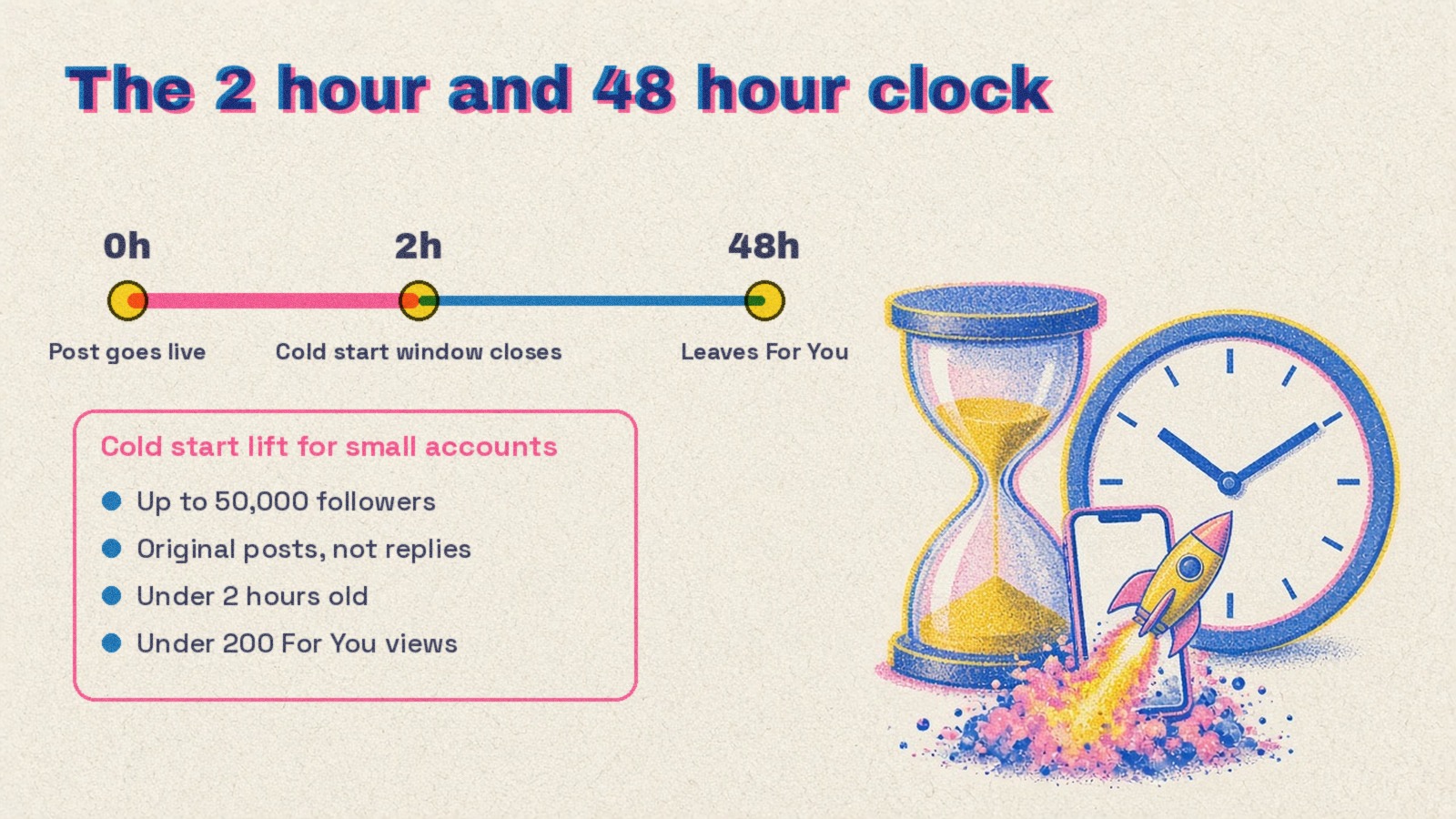
Every post drops out of For You after 48 hours. There's an age filter in the code set to exactly that.
The first two hours matter even more for smaller accounts. The code has a cold start rule for authors with up to 50,000 followers. An original post that's under two hours old and has fewer than 200 For You views can be lifted into a slot around position 15 or 16 in a viewer's feed. X runs this as an experiment, so not every viewer gets it. Still, those first 120 minutes are your best shot at being discovered, so I post when my audience is awake and I stay around to reply.
4. Hashtags won't save a post
None of the ranking weights look at hashtags. X turns the text and images of each post into numbers that describe what it's about and matches them to people with similar interests. The only places I found hashtags in the code are a record of people clicking them and an older helper that keeps up to four per post.
So skip the #entrepreneur #grindset clutter. One relevant tag is fine. A wall of them just makes the post harder to read.
Never copy and paste text into X
This is the rule I care about most, and it isn't in my Reddit post.
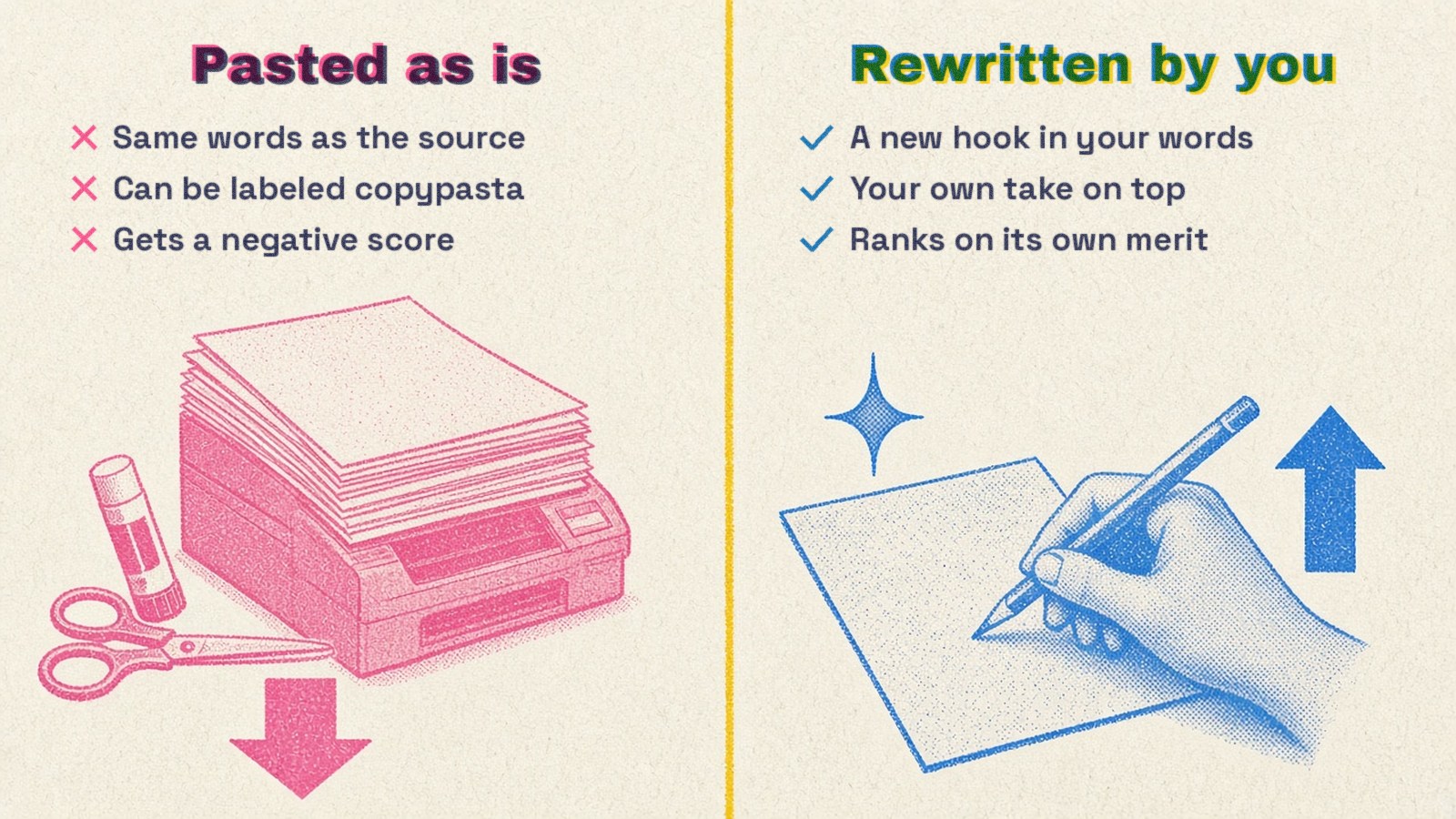
If you copy and paste text into X, your post gets a negative score. So you must always modify the text when you copy and paste.
I see people do this every day. They copy a thread from LinkedIn, a caption from Instagram, a quote from an article or a reply from an AI chatbot and paste it straight in. Sometimes they paste the same promo under fifty different posts. It feels efficient. It quietly works against you.
The open code backs up why I'm so strict about it. X runs rules that find clusters of posts and replies sharing duplicate text and tag them with a label called COPYPASTA_SPAM. The rules even call the note they write a downrank note. The public code doesn't show exactly how much that label costs you, so I won't put a number on it. But I'm not willing to find out the hard way, and you shouldn't be either. X also has a transparency tool called Under the Hood that shows statistics about labels on your own account and posts that can limit visibility, so you can check yours.
Here's how I modify copied text before it goes on X.
- Rewrite the first line in my own words. The hook should never match the source.
- Add my own take. One sentence of opinion or experience turns a copy into a new post.
- Change the structure. A paragraph becomes a short list, or a list becomes two punchy lines.
- Cut it for X. Text written for LinkedIn or a blog is almost always too long here.
- Never repeat the same reply. Every reply gets written for the post in front of me.
- Quote, don't paste, when sharing someone else's post. A quote adds my words and gives them credit.
Here's the difference at a glance.
| Pasted as is | Rewritten in your words |
|---|---|
| Same text as the source and as everyone else who pasted it | Unique to you and to this post |
| Can be grouped with duplicates and labeled copypasta | Ranked on its own merit |
| Reads like it was written for another platform | Reads like X |
| Gives people little reason to reply or share | Adds a take people can react to |
Myths versus what the code says
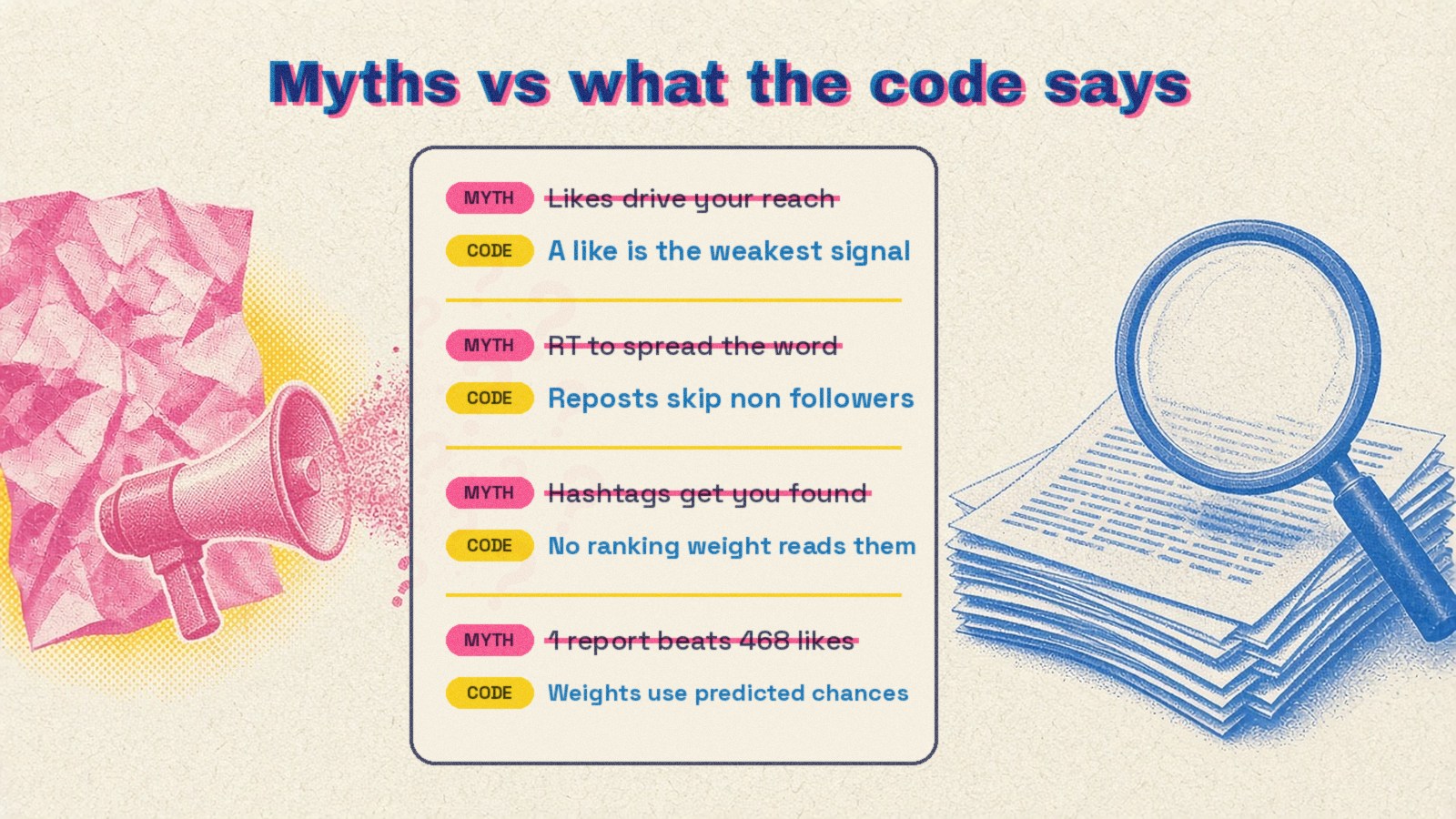
| Myth | What the code says |
|---|---|
| Likes are what get you reach | A like is the weakest positive signal, at 0.708 |
| Ask people to RT to spread the word | A repost is worth 1 and is filtered out for non followers |
| Hashtags help you get found | No ranking weight looks at hashtags |
| One report cancels hundreds of likes | Weights apply to predicted chances, not raw counts |
| A post keeps working for days | Posts leave For You after 48 hours |
| Engagement pods and group chats boost you | Only actions on posts served in Home count for ranking |
My X playbook for 2027

This is what I do now, based on what the code actually rewards.
- Write posts worth copying. Checklists, templates, numbers and clear how to's get saved and shared. Ask yourself, "Would someone send this to a friend?"
- Start conversations, not monologues. End with a real question. Replies are worth 5, and up to 20 from mutuals.
- Reply to everyone in the first two hours. That's when the cold start window is open and when conversation helps most.
- Build real mutuals. Follow and talk with people in your niche. The mutual reply boost rewards relationships, not reach hacks.
- Quote instead of repost. Always add your take.
- Write things people read to the end. X's notes say the ranking model now predicts time spent better and retrieval surfaces posts people read all the way through.
- Space your posts out. The ranking service has an author diversity setting, so each extra post from you in the same feed load counts for less. Your second post gets about 63 percent of its score and the third about 44 percent.
- Never paste text as it is. Modify everything, every time.
If you want more on the daily habit side, my guide to building a daily social media engagement routine in 20 minutes walks through how I fit this into a busy day.
Where Engagi fits
Most of this playbook comes down to one thing, which is showing up in the right conversations with something worth reading. That's slow by hand, and it's exactly where people get lazy and start pasting the same reply everywhere.
That's why we built Engagi, a Chrome extension that adds a button to the reply bar on X and 13 other networks. One click and it reads the post and writes a reply that fits it, in the mood and length you pick. Every reply is written fresh for that post, so you're never pasting the same line twice. It knows which platform you're on, so an X reply reads like X. You can block words you never want it to use, and it never posts anything by itself. You read the reply, change what you like and post it yourself.
That last part matters. I still tweak most replies before posting, which is exactly the habit I want you to have. If you're comparing tools, my roundup of the best AI comment generators for Reddit, LinkedIn and X covers the other options too.
A few common questions
Is the X algorithm really open source? Yes. X publishes the code for its For You feed in the xai-org/x-algorithm repository on GitHub and updates it often. It also says a few files, like some of its spam rules and the prompts used by its content classifiers, aren't published.
What is the most valuable action on X right now? In the current code, Copy Link has the highest positive weight at 20. Reply, Quote and Share via DM are next at 5 each.
Do likes still matter? A little. A like has a weight of 0.708, the lowest of the main positive actions. Likes are nice to see, but they won't carry a post.
Does one report kill a post? Not the way people think. X's code says the weights apply to predicted chances for each viewer, not to raw counts, so you can't convert reports into likes. Reports still carry the heaviest weight, so avoid giving people reasons to report.
Should I stop using hashtags? You don't need them. None of the ranking weights look at hashtags. One relevant tag won't hurt, but a pile of them won't help either.
Why shouldn't I copy and paste text into X? Because in my experience pasted text gets a negative score, and X's open code has rules that label duplicate text in posts and replies as copypasta spam. Always rewrite copied text in your own words before you post it.
How much does Engagi cost? Engagi is $6.99 a month or $67 a year, with a 30 day money back guarantee. See the Engagi site for current plans.
Stop guessing and start growing on X
The X algorithm isn't a mystery anymore. It rewards posts people share, conversations between real connections and fresh, original writing. It punishes anything that makes people mute, block or report you, and it has no patience for copied text.
If you want to show up in more conversations without spending your whole day writing replies, Engagi writes a fresh, human sounding reply for every post in one click, on X and 13 other networks, for $6.99 a month or $67 a year. Get Engagi and turn the replies you'd write anyway into reach.